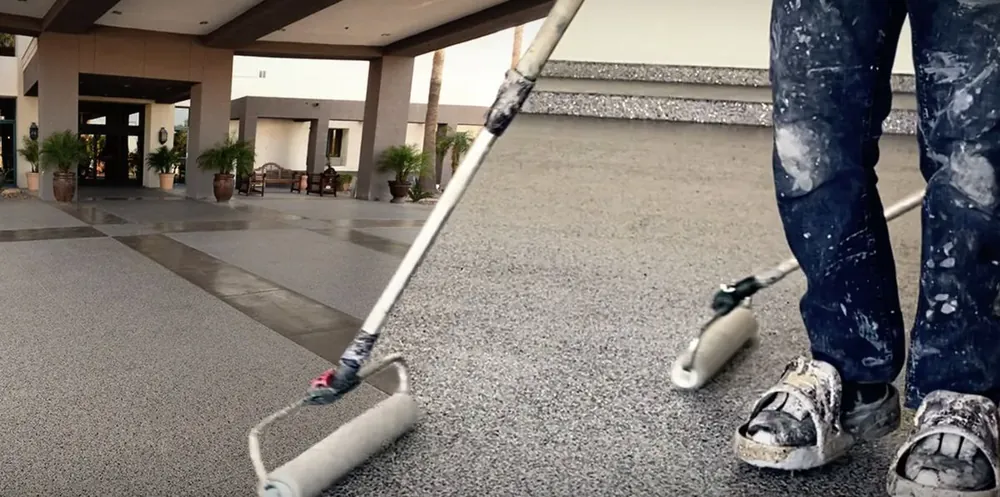
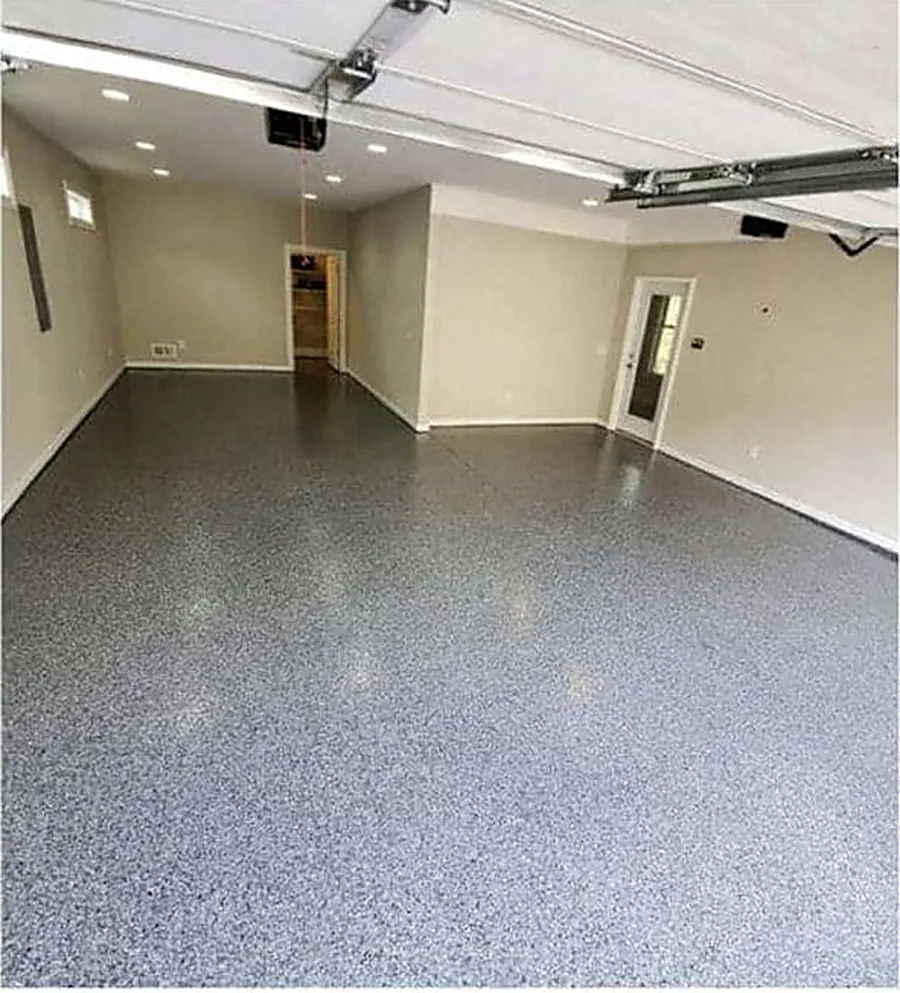
Polyaspartic is a resin coating in the polyurea family, and the practical difference from epoxy comes down to three things: it cures in a fraction of the time, it stays flexible when concrete moves, and it doesn't yellow in sunlight. For Nebraska, the first two matter enormously.
An epoxy floor needs the slab above roughly 50°F to cure properly, which shuts down a lot of Omaha garage work from November through March. Polyaspartic cures at temperatures well below freezing, which means a heated-garage job in January is genuinely possible rather than a coin flip. And because it stays flexible, it tolerates the expansion and contraction that our freeze-thaw swings force through a slab every winter.
Most of what we install in Omaha is a hybrid: an epoxy base coat for build and adhesion, with a polyaspartic topcoat doing the wear and UV work. That combination costs less than an all-polyaspartic system and outperforms all-epoxy.
Base Coat & Flake Broadcast
Clear Topcoat Over Flake
Why Does Polyaspartic Suit Nebraska Weather?
It cures in the cold. Application is workable in temperatures where epoxy simply won't set, which opens up winter scheduling instead of a six-month waiting list every spring.
It flexes instead of cracking. Omaha slabs move through freeze-thaw cycles all winter. A rigid coating telegraphs those movements as cracks; a flexible one absorbs them.
Road salt doesn't touch it. De-icer that pits bare concrete and etches lesser coatings runs off a polyaspartic surface without damage.
It won't yellow. Epoxy ambers over time under UV, which shows badly on light colors near a garage door or a walkout basement slider. Polyaspartic stays true.
One day, in and out. Most residential jobs are ground, coated, and topcoated in a single day, with the car back in overnight.
What's the Catch With Polyaspartic?
Two things, and any honest installer will tell you both.
First, it costs more. Material price is higher than epoxy and the gap shows up on the quote, generally $5 to $10 per square foot versus $3 to $7 for a standard epoxy system.
Second, and more important, it's unforgiving to install. The working time is short — sometimes under 20 minutes depending on temperature and mix. There's no going back to fix a roller mark once it starts to set. Epoxy gives a crew room to work; polyaspartic does not. A crew without real polyaspartic experience will leave lap lines and roller stipple that you'll be looking at for the next fifteen years.
If your only priority is the lowest number on the quote and the garage is unheated anyway, a well-installed epoxy system is a perfectly good answer and we'll say so.
What Does Polyaspartic Cost in Omaha?
Polyaspartic in Omaha runs roughly $5 to $10 per square foot installed, typically 30 to 50 percent above a comparable epoxy system.
Application
Approx. Square Footage
Typical Price Range
2-car garage
400–500 sq ft
$2,000 – $5,000
3-car garage
600–750 sq ft
$3,000 – $7,500
Hybrid epoxy base + polyaspartic top
400–500 sq ft
$1,600 – $3,800
The hybrid line is where most Omaha homeowners land. It captures the UV stability and wear resistance of polyaspartic on the surface, where it matters, while using epoxy for build underneath, where nobody sees it.
One day on site and the car goes back in overnight. Epoxy takes two to three days before vehicle traffic.
❄
You're Coating in Winter
If it's December and you don't want to wait until May, polyaspartic is realistically the only option.
☀
Sunlight Reaches the Floor
South-facing garage doors, walkouts, and sunrooms. Epoxy ambers there within a few years; polyaspartic doesn't.
💵
Budget Is the Priority
For an unheated garage with no rush and no direct sun, epoxy delivers most of the performance for meaningfully less money.
Frequently Asked Questions
Is polyaspartic really better than epoxy?
+
Better for some things, not universally. Polyaspartic cures faster, stays flexible through Nebraska's freeze-thaw cycles, and holds its color under UV where epoxy turns amber. Epoxy builds thicker per coat, costs less, and is far more forgiving to install. The honest answer for most Omaha garages is a hybrid system: epoxy base, polyaspartic topcoat.
Can you really install polyaspartic in an Omaha winter?
+
Yes. Polyaspartic cures at temperatures well below what epoxy tolerates, so a garage that holds any heat at all is workable through January and February. We still check slab temperature and moisture before starting, because a frozen or damp slab is a problem for any coating. But we're not telling customers to wait until spring the way an epoxy-only crew has to.
How long does a polyaspartic floor last in Nebraska?
+
Fifteen to twenty years is a realistic expectation for a properly prepped residential floor. The flexibility is what earns the extra years here specifically, because it absorbs the slab movement that our winters force rather than cracking along with it. Prep is still the deciding factor. A polyaspartic coating over a poorly ground slab will fail just as fast as anything else.
Why is polyaspartic more expensive?
+
Two reasons. The raw material costs more than epoxy resin, and the installation demands more skill because of how quickly it sets. You're paying for a product with a short working window applied by someone who has done it enough times to work clean. Crews who quote polyaspartic at epoxy prices are usually using a hybrid and calling the whole floor polyaspartic.
Does polyaspartic smell as strong as epoxy during installation?
+
It has less odor and off-gasses far more quickly, which is a real advantage for attached garages and basements where fumes migrate into the house. Most Omaha customers notice little to nothing by the following morning. We still ventilate the space during application.
Can polyaspartic go over an existing epoxy floor?
+
If the existing epoxy is fully bonded and in decent shape, yes. We test adhesion in several spots, then mechanically abrade the entire surface so the new coat has something to grip. If the old coating is peeling, bubbling, or lifting anywhere, it comes off first. Coating over a failing floor just means you pay twice.
Want Your Floor Done in One Day?
Polyaspartic makes winter installs and single-day turnarounds possible. Call and we’ll tell you honestly whether it’s the right call for your slab.